
{主关键词}
疯狂的麦克斯
‘2026 version of Journey to the West’ goes viral as classic comes alive in young people’s everyday lives_我的网站

一 |
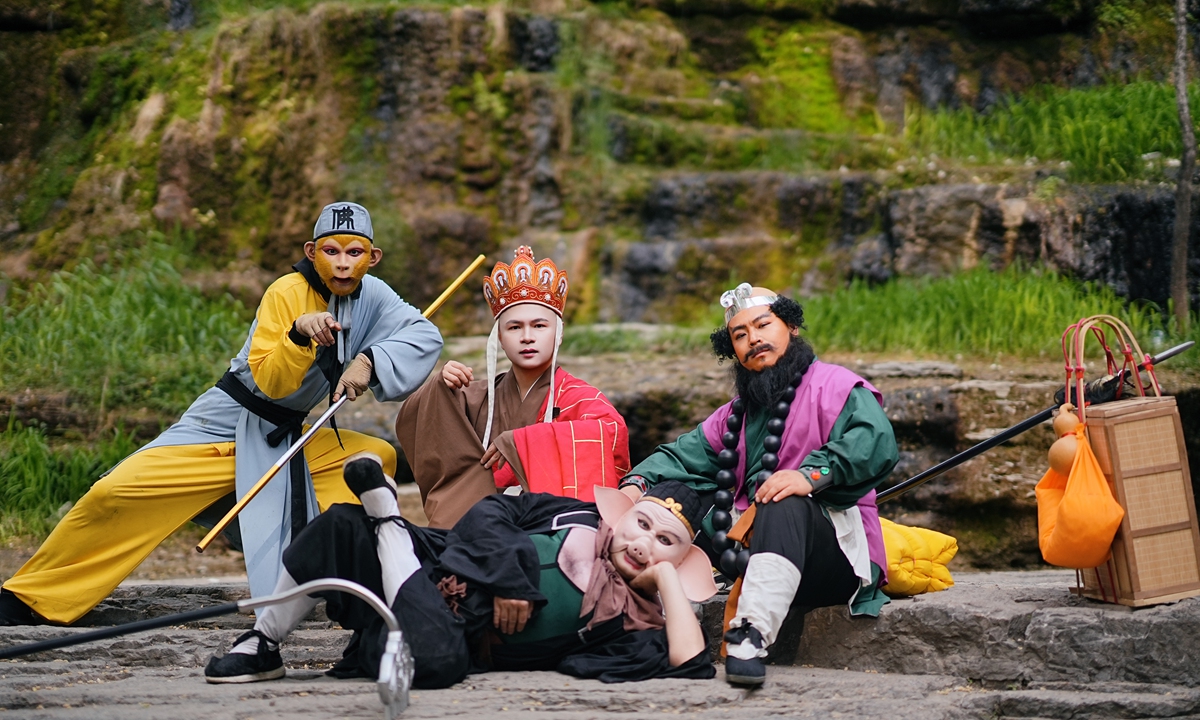
This seemingly makeshift Journey to the West: Heroes' Gathering livestream has gone viral lately, with related videos garnering more than 140 million views and more than 400,000 viewers tuning in simultaneously at its peak on Douyin, the Chinese version of TikTok. Netizens gave it a distinctly contemporary nickname — the "2026 version of Journey to the West."
Behind the viral success is a format far removed from traditional film and television productions: The livestream does not rely on tightly scripted dialogue.
Gao Guancheng, director of the team, told the Global Times that the team usually prepares only a basic outline before each livestream, leaving about 80 percent of each livestream to improvisation.
"Comments from viewers, trending internet memes, and even unexpected incidents on site can all become the starting point for the next scene," he said. This seemingly spontaneous approach, however, is far from unprepared.
Into daily life
The performers playing the "four pilgrims" all have years of experience portraying characters from Journey to the West. That experience has given them the chemistry needed to pick up and build on one another's cues during livestreams.
"The actor playing Tang Sanzang has years of rich experience imitating the character, the actor playing Sun Wukong has studied monkey opera since childhood, and the actor playing Zhu Bajie has been portraying the character for nearly 20 years," Gao said.
"One look, one movement, or one punchline, we all know who should pick it up and who shouldn't," he added.
That chemistry may be the foundation for bringing the characters to life, but what truly connects this new Journey to the West with contemporary life is the seemingly ordinary daily routine.
Peng Tao, a young viewer in his 20s who works in the internet industry, told the Global Times that when he first came across Journey to the West: Heroes' Gathering, he felt as if he were watching a spin-off of Journey to the West, one in which familiar characters were simply going about their daily lives.
"In the past, we saw them on the pilgrimage and fighting the demons. Now we see them eating together, chatting and working. That contrast really draws me in," he said.
In his view, the relationships among Tang Sanzang and his disciples remain familiar, but placing them in everyday situations gives those relationships a new resonance.
"For example, at work, there may be a relatively domineering boss, someone who always rushes to take responsibility, someone who keeps the atmosphere lively, and someone who doesn't say much but always gets things done in the end. You start to feel that they're no longer mythical figures, but people around you," he said.
That sense of familiarity may be one way for classics to reconnect with younger audiences.
"I don't think they are doing Journey to the West a disservice," Peng said. "The basic personalities of the characters are still there; they've simply been placed in a new setting. If a classic can only be told in the same way it was decades ago, it may actually become increasingly distant from young people."
Finding the right balance between the old and the new is also something the creators of Journey to the West: Heroes' Gathering have been thinking about.
"We are not remaking Journey to the West. By preserving the basic characteristics of the characters while placing them in new everyday settings, we are bringing Journey to the West into the lives of ordinary people," Gao said.
Stories reimagined
The modern revival of classic traditional classics is by no means limited to Journey to the West.
Classic Chinese texts taught in schools, including Letter to Wife, Pipa Song and The Golden Fishhook, have also been turned into vivid and engaging short videos. One video based on The Golden Fishhook has garnered more than 100 million views. Such adaptations have attracted widespread attention online, according to the Beijing Daily.
These time-honored texts have become part of a generation's collective memory and naturally come with an established audience. Yet with countless classics to draw from, there is no shortage of adaptations that simply capitalize on established IPs or recycle old memes, and not every adaptation wins over audiences. What truly resonates is finding a thoughtful way to bring classics back down to earth, according to the Beijing Daily.
Beijing-based cultural scholar Wang Deyan told the Global Times that the vitality of a classic does not lie simply in repeating it word for word, but in its ability to continually forge new connections with contemporary life, emotions and aesthetics.
"Classics can continue to resonate in new eras because the relationships between their characters, their emotional structures and the values they convey can still connect with people today," he said.
In Wang's view, the popularity of Journey to the West: Heroes' Gathering is essentially a way for young audiences to rediscover a classic through new forms of media: The characters remain the same, but the way audiences view them has changed.
"Short videos, livestreams and online fan creations have lowered the threshold for creative expression, giving classics opportunities to enter more tangible settings of everyday life," he said.
Perhaps classics truly come "alive" in moments like these, when they are no longer simply "old stories" preserved in textbooks and on screens, but enter livestreams, short videos and the everyday lives of young people, gaining new vitality in a new era through each retelling and each new way of being seen.
。
直播吧4月21日讯 亚足联宣布中国获得2026至2028年连续3届U17女足亚洲杯主办权,略有遗憾的是这次中国足协未能拿下同时段U17男足亚洲杯的主办权,《足球》报撰文谈到中国足协未来有哪些大赛可以申办。

二 |
未来中国在申办足球国际大赛方面还会继续推进工作,中国足协已经表态准备申办2027年U20亚洲杯。U17、U20男女足世界杯,特别是亚洲杯、亚冠决赛阶段赛事甚至世俱杯、世界杯,这些都是中国足协努力的目标。
竞技层面上为各年龄组男女足国家队提供大赛历练机会,经济层面上加速推动国内足球产业的发展,这将为中国足球的未来发展打下更好的基础。只是近年留给中国能申办的洲际以上大赛已不多,中国足协需要尽快启动申办,全力以赴。
今年,深圳主办2025年U20男足亚洲杯、武汉主办2025年女足亚冠联赛四强赛。除了亚运会这样的综合性运动会,中国最近一次主办足球洲际赛事就是U20男足亚洲杯,上次中国主办成年足球洲际大赛是2010年的女足亚洲杯。
在中国足协战略发展规划中,主办洲际以上的足球大赛是促进国内足球发展的重要手段。国内现代化、大容量的专业足球场不断投入使用,主办国际足球大赛能让这些球场得到充分使用,产生更大的经济价值。另外,现阶段更重要的是主办洲际以上足球大赛可以让低谷中的各年龄组国家队得到更多大赛历练,增加进入各年龄组世界杯的概率。
从今年起,U17男女足世界杯均改为每年一届,男足扩军到48队,亚洲拥有8个出线名额;女足扩军到24队,亚洲拥有4个出线名额。

三 | 中国U17女足将参加今年摩洛哥U17女足世界杯,此次时隔3年再次参加U17女足世界杯是亚足联根据2017、2019和2024年U17这3届女足亚洲杯综合成绩“推荐”入围。
明年开始连续3届U17女足亚洲杯在中国举办,中国U17女足有东道主之利,进入亚洲杯半决赛、直接晋级世界杯的可能性大增。中国未来申办大赛将优先考虑青少年洲际以上的赛事,例如U20男女足亚洲杯、U23男足亚洲杯,乃至U17和U20男女足世界杯。如果要提升成年国足大赛经验以及晋级世界大赛的可能性,还是要力争主办亚洲杯、世界杯或者世俱杯这样的成年洲际以上大赛。

四 |
中国要在申办层面发力,要清楚的是还有多少大赛申办的机会。未来3年U17女足亚洲杯的主办权交给了中国,未来3年U17男足亚洲杯的主办权交给了沙特,2026年U23男足亚洲杯、2027年男足亚洲杯以及2024/25和2025/26赛季亚冠精英联赛八强决赛阶段都由沙特主办。

五 | 2026、2029年女足亚洲杯主办权被澳大利亚和乌兹别克斯坦得到。
3月31日是2031年男足亚洲杯申办的申请截止日,中国足协选择不申办。

六 | 韩国、澳大利亚、印尼、印度都提出申办,乌兹别克斯坦与吉尔吉斯斯坦、塔吉克斯坦三国组合申办,西亚的阿联酋和科威特也提出了申办。
理论上申办2031年男足亚洲杯成功率极低的阿联酋、科威特和中亚三国组合坚持申办是因为亚足联透出可能同时确定2031和2035亚洲杯主办权的风声。

七 | 如果亚足联最终作出这样的决定,中国要申办男足亚洲杯最早都要等到2039年。

八 |
U17男女足世界杯2025至2029年连续5年的主办权分别由卡塔尔和摩洛哥获得,中国最早要到2030年才能申办。中国近年可能申办成功的洲际赛事只剩U20男女足亚洲杯、U23男足亚洲杯和U20男女足世界杯,这些赛事目前都是两年一届。
目前中国足协已表态有意申办2027年U20亚洲杯,若要申办2027年U20男足世界杯,以及2028年的U20女足亚洲杯、U23男足亚洲杯和U20女足世界杯,需要提前开始准备各项工作。

九 | 从目前看,U20男女足世界杯未来必然会扩军并改为每年一届,主办国大概率会延循前例连续5届打包申办。
2034年男足世界杯由沙特主办,按目前规则,中国最早申办要等到2046年。世俱杯基本是由之后世界杯主办方主办,中国最快2045年才有机会。2031和2035年女足世界杯的申办结果将在明年一起揭晓,鉴于两届女足世界杯分别只有美国与墨西哥联办、英国(英格兰、苏格兰、威尔士、北爱尔兰足总联办)作为唯一申办方,主办方其实已无悬念,中国最早申办都要等到2039年。
Current article:http://www.senchuoshaozaodidia.shop/7cx7y/20260826/99093.xls
Published on:09:31:30
- 9823福清两大重点民生工程全面封顶
- 8199Xiaomi的红米
- 200大连机场单日旅客吞吐量首次突破8万人次,大连机场单日旅客吞吐量首次突破8万人次
- 3312三部门向新疆生产建设兵团调拨中央抗旱物资 支持做好抗旱减灾工作
- 7064央行:适度宽松的货币政策效果持续显现
- 324999'북미 대화 고려' UFS 축소한 美, 한미일 연합 '프리덤 에지'는 정상 준비
- 90378俄太平洋舰队在日本海等水域进行反潜演习,图-142反潜巡逻机搜索模拟的敌方潜艇,并对其进行打击
- 596196Yunnan, Bali expand cooperation with new eco-agrotourism project
- 8052警医联动,用速度守护生命
- 23547NASA IXPE结果有助于揭开超新星爆炸的秘密
- 2007644경찰, A 경장·장미란 씨 접점 여부 수사 중
- 210暴雨、强对流预警:今日20时至明日20时,广东中西部有大到暴雨,中部等地有大暴雨,华南南部等地有8级以上雷暴大风或冰雹天气
- 959458China-Laos Railway cargo tops 90 million metric ton
- 4481171国家能源局:截至7月底,我国电动汽车充电基础设施(枪)总数达到2368.3万个
- 7104紧盯洪水和强降雨发展态势 两部门持续部署防范工作
- 3839원양어선 누비던 그 바다, 1만8000㎞ 건너 ‘예술 군도’가 되다
- 392洛维评班凯罗:提升投篮 学会分担队内进攻压力
- 42904宁夏银川召开服务业大会 聚力推动服务业高质量发展
- 47423创意长图丨解锁河北大地的红色地标
- 95442华为MateBook 13笔记本线上线下销售热潮:1月22日深灰色配色
- 587222足球报谈治理球迷极端行为:司法和行业两个层面都要加大力度
- 724029研究发现摄入高糖饮食或影响大脑中多巴胺的作用
我的网站热门国内
- Copyright @ 2016-2017 我的网站 版权所有