银魂
TCM used to treat patients on flights_我的网站

A |
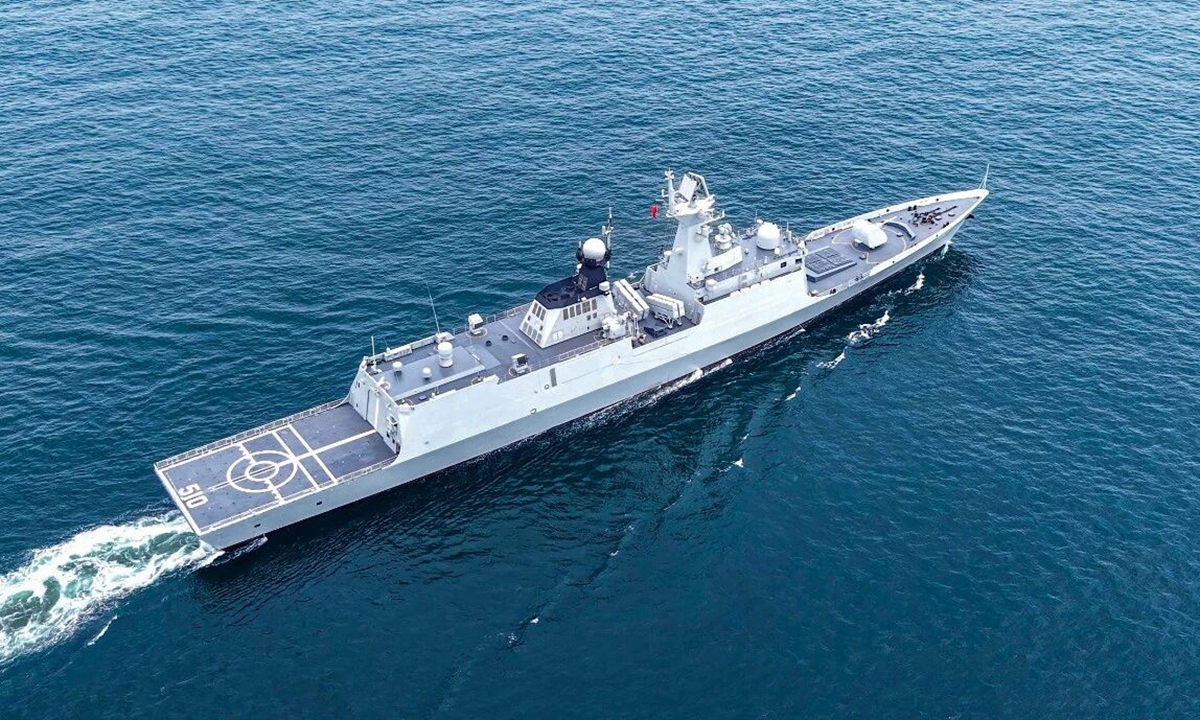
Image of the PLA Navy Type 054A guided missile frigate
Ningde Photo: China Military BugleState media released footage on Saturday showing the latest training scenes of the Type 054A guided missile frigate Ningde, marking its official commissioning into the Chinese People's Liberation Army (PLA) Navy.
The vessel inherits the hull number 510 from its predecessor, a smaller Type 056 guided missile corvette also named
Ningde.
Recently, the
Ningde, assigned to a frigate flotilla under the PLA Eastern Theater Command, formed a task group with multiple vessels to conduct combat-oriented training, testing command coordination and emergency response capabilities while accelerating combat readiness generation, according to the military channel of state broadcaster CCTV News.
As threats emerged from both sea and air, radar stations quickly locked onto targets and reported the tactical situation. Weapons systems prepared for engagement. Following the commander's order, the main and secondary guns opened fire in succession, delivering intensive strikes and neutralizing the simulated threats, the report said.
Amid rolling waves, the vessel conducted replenishment drills. Subsequently, the
Ningde focused on specialized training in areas including helicopter takeoffs and landings and damage control, further honing its combat skills, said the report.
The new Ningde has drawn attention from Chinese military enthusiasts, who remarked that the PLA Navy's modernization is moving at an astonishing pace, as the previous Type 056 Ningde had been in service for only about a decade, according to Shanghai Observer.
The continued production and upgrade of the Type 054A have effectively filled the gap in coastal and offshore combat capabilities, providing the navy with a large number of cost-effective platforms for both near-sea and far-sea operations, helping maintain a sustained combat readiness, Zhang Junshe, a Chinese military affairs expert, told the Global Times on Sunday.
Mass production has reduced unit procurement and maintenance costs, standardized training, logistics and command systems, and significantly improved the overall efficiency of the Navy's equipment system, Zhang said.
The Type 054A guided missile frigate belongs to the PLA Navy's most numerous and cost-effective medium-sized frigate program of the past two decades, often described as a "maritime multi-role platform."
With the addition of the
Ningde, the Type 054A fleet has now reached 46 vessels, Zhang said.
The Type 054A is equipped with 3D radar, low-altitude gap-filling radar and a towed array sonar system, forming a three-dimensional detection network covering sea, air and underwater domains. With a range of 4,000 nautical miles, it is suited for long-duration far-sea missions and possesses strong integrated combat capabilities in coastal and offshore waters, as well as far-sea escort capabilities. Its weapon systems are well balanced through successive upgrades, Zhang said.
In January 2026, CCTV announced a newly upgraded version of Type 054A frigates.
Compared with the original design, the upgraded version features an extended flight deck better suited for new shipborne helicopters, addressing a previous shortfall in aviation-based anti-submarine warfare. The main gun has also been upgraded to a 100mm caliber, similar to that on the Type 054B, with improved radar range and accuracy.
PLA Navy has developed the Type 054B frigate as a next-generation successor to the Type 054A.
On January 22, 2025, the lead ship of the Type 054B,
Luohe, was commissioned at a naval port in Qingdao, East China's Shandong Province, followed by the second ship,
Qinzhou, in March, reported CCTV.
The Type 054B frigate displaces approximately 5,000 tons and features a new propulsion system, stealth design, integrated mast and advanced multi-functional vertical launch system capable of firing various missile types. It has achieved breakthroughs in stealth technology, combat command systems and fire control integration, said the CCTV report.
Despite this, China continues to upgrade and build the Type 054A frigate. Zhang said that the Type 054A and Type 054B form a clear "high-low mix, mission complement" structure.
The Type 054B is positioned as a larger far-sea vessel, primarily tasked with core escort and high-end confrontation missions in far-sea formations. The Type 054A serves as the main coastal and offshore combat force and a supplementary far-sea asset, responsible for near-sea defense, routine patrols, anti-submarine warfare in offshore waters, and escort missions for far-sea formations. This avoids equipment homogenization and enables efficient synergy, Zhang said.
The Type 054A features mature technology, stable production lines, fast construction and high cost-effectiveness, enabling rapid mass deployment at relatively low cost. Meanwhile, the Type 054B, as a new model, still comes with a higher price tag.
Given the Navy's continuous demand for more vessels, continued construction of the Type 054A quickly fills the coastal and offshore capability gap, while the Type 054B gradually replaces some older vessels and enhances far-sea integrated combat capabilities, Zhang noted.
。 A recent in-flight medical emergency highlighted how traditional Chinese medicine techniques can complement emergency care in unexpected settings. Four faculty members from the Beijing University of Chinese Medicine responded to a medical emergency aboard an overnight Air China flight from Paris to Beijing, using a combination of conventional assessments and TCM therapies to help an 11-year-old passenger whose condition later stabilized. At about 3 am Beijing time on July 20, cabin crew issued an urgent call for medical assistance after the Chinese girl, who was returning from a performance in France, developed chest pain, alarming her family. Four BUCM faculty members immediately came forward: Wang Ting, the university's vice-president; An Chao, deputy director of the International Cooperation Department; Chen Younan, associate dean of the School of Acupuncture-Moxibustion Tuina; and Zheng Fengjie, dean of the School of Traditional Chinese Medicine. After checking the girl's blood pressure, body temperature and heart rate, they identified persistent pain in the chest area as her primary symptom. The team administered oxygen and placed a TCM pill under the girl's tongue to promote blood circulation and relieve pain. They also applied acupressure and massage techniques, focusing on several acupoints including Neiguan, located on the inner forearm about two to three finger widths above the wrist crease, between the tendons of the palmaris longus and flexor carpi radialis muscles. According to TCM theory, stimulating the Neiguan acupoint is believed to help regulate heart function, calm the mind and relieve chest discomfort. Working in the cramped cabin, the four physicians took turns kneeling beside the girl while monitoring her condition. Her chest pain gradually subsided. After the aircraft landed in Beijing, the crew arranged for ground medical personnel to continue her treatment. Later reports revealed that her condition had stabilized. Wang said the emergency response demonstrated that TCM can play a role in certain acute situations when used alongside standard medical assessments. "The treatment combined sublingual administration of a traditional Chinese medicine pill with acupressure techniques," he said. "Together, they helped relieve the child's symptoms by promoting blood circulation and easing the chest pain." He added that many people associate TCM mainly with chronic disease management and health maintenance, while overlooking its potential applications in emergency situations. "Herbal medicine, acupuncture and tuina are not limited to long-term care," Wang said. "We hope more people, both in China and abroad, will gain a better understanding of the role traditional Chinese medicine can play in emergency care." The July incident was not the first time faculty members and students from BUCM provided medical assistance aboard flights. On June 28, 2024, doctoral student Cao Feng used acupuncture to help revive a woman who had lost consciousness aboard a flight from Beijing to Lanzhou in Gansu province. And on Oct 9, 2024, student Gao Yingjun administered acupressure to assist a Russian passenger suspected of having a stroke on a flight from the Maldives to Shanghai. More recently, on Jan 1 this year, doctoral student Yang Yao used acupuncture on the Neiguan acupoint to help treat a passenger experiencing a hypertensive emergency aboard a China Eastern Airlines flight. For the university, these incidents illustrate how medical professionals trained in TCM can contribute when emergencies arise unexpectedly, even thousands of meters above the ground.


。
Current article:http://www.senchuoshaozaodidia.shop/anw/q9x0w.pptx
Published on:05:33:52

 。
。 微信
微信 移动端
移动端


