
作者:海平王
来源:原创
时间:2026-08-26
阅读:20761 次
国考
“桑拿天”来了 防暑别松懈_我的网站

一 |
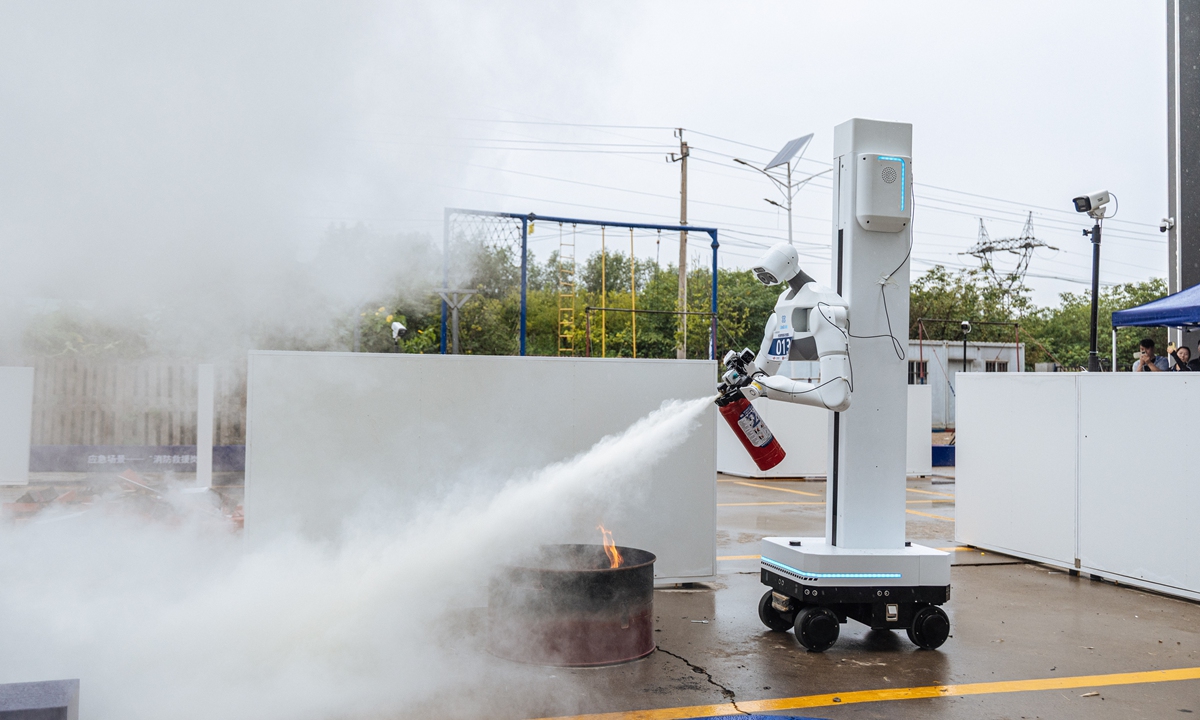
The firefighting final of the emergency management category at the 2nd World Humanoid Robot Games (WHRG) was held on Sunday in Beijing, putting 23 teams through a simulated rescue operation designed to test whether humanoid robots can move beyond demonstrations and perform practical tasks in complex real-world environments.
The event comes as Chinese humanoid robots, long known for eye-catching abilities such as running, dancing and music playing, are pushed toward practical applications, including jobs that are dangerous for humans such as emergency rescue.
Unlike the first edition of the WHRG last year, according to the organization committee, this year's scenario-based events emphasize "realistic simulation," with the firefighting competition being held at a fire brigade rather than in a model-room setup.
The competition simulated a firefighting assignment that required each of the 23 robots to complete three tasks within 30 minutes: identify hazardous materials, shut off valves and operate a fire extinguisher. For the first task, robots had to identify two randomly placed simulated hazardous substances and report their types to judges through returned images. They then had to locate three randomly selected open valves of different types and shut them off before identifying a fire source, finding a fire extinguisher and spraying it until the fire was put out.
Human firefighters were also involved in the event, lighting the fire and observing whether the robots carried out the extinguisher operation correctly.
The competition, however, showed how difficult it remains for robots to perform reliably outside controlled laboratory conditions.
Rain affected the competition, while changes in lighting and the outdoor environments added uncertainty to the robots' visual recognition and manipulation tasks. A team from UniX AI, a company well-known for its robot applications on real-world scenarios and has just raised a new round of 300 million yuan ($ 44.49 million) in late March, completed its run within the allotted time, but its robot moved relatively slowly compared to human firefighters' real practice. When operating the fire extinguisher, its robotic hand had to make two attempts to align with the target.
Of 12 teams competed on Sunday, three finished the challenge.
Yang Liqi, a representative of the UniX AI team, told the Global Times that the firefighting scenario placed higher demands on both the robot's recognition and manipulation capabilities.
"Rain and lighting conditions can affect the robot, and actual situations are often different from what we simulate in the laboratory," Yang said, noting that this was also one reason why a number of teams were unable to complete their runs on Sunday morning.
The team had programmed the robot to make up to three attempts when operating the extinguisher. "If it sees white smoke after the first attempt, it will not make a second attempt," Yang said.
The difficulty was not simply that whether the robot could move its arm. Humanoid robots rely on different types of joints for different tasks: small, high-precision joints enable delicate hand operations, while high-torque, reliable joints support movement and balance.
A failure at any point of actions and detection could affect the final result. This is precisely where the value of real-world competitions lies, Jin Chenran, a representative of the Tiangong team whose robot only accomplished one of the three tasks, told the Global Times.
"Whether the competition goes smoothly or not, that is the significance of a real-world simulation. Every real-world failure is valuable data that helps humanoid robots toward practical application," Jin said.
Jin further explained that questions like why the robot failed to recognize an object and how its motion-planning system selected the wrong path... Such data can subsequently be used to improve algorithms and train AI models.
The competition also offered a glimpse into the current transitional stage of humanoid robot technology. At the venue, some team members were wearing VR headsets and remotely adjusting their robots shortly before their runs.
Some humanoid robots were seen using omnidirectional wheels instead of feet, while their hands featured multiple joints to enable more precise manipulation. Many teams chose China-developed UBTECH's joint modules for their robots. Its servo actuators cover a wide torque range from 0.2Nm to 200Nm, allowing robots to combine dexterity with strength. Meanwhile, VR teleoperation gives operators a first-person view through the robot's cameras, enabling them to remotely guide movements in real time.
The event comes amid a broader push in China to move humanoid robots and embodied intelligence from laboratories and competition arenas into real production and daily-life environments. In June, the Ministry of Industry and Information Technology and the other departments launched a special program for humanoid robots and embodied intelligence that encouraged applications in practical fields including emergency rescue.
Zhao Weidong, deputy director of the organizing committee office, told the Global Times that the scenario-based competitions are intended to test the progress of humanoid robots from "competition performance" toward "real operational work," including whether they can eventually become intelligent partners for firefighters.
"At present, many simulations of actual operations may still be at an early stage," Zhao said. "But these are an important starting point for enabling robots to truly assist humans in real-world environments, as well as an important source of data and testing."
The ultimate goal, Zhao said, is to push robots into fields where human operations are dangerous and achieve genuine "human-robot complementarity."
。 随着低涡切变系统逐步东移,杭州持续多日的雷阵雨天气明显减弱,久违的阳光重新上线。据市气象台预报,未来两天,此前暂退的副热带高压将再度加强西伸,受其影响,杭州气温将持续攀升,主城区午后最高气温将达33℃至35℃,且午后多分散性雷阵雨天气,市民外出记得随身备伞,兼顾遮阳和挡雨。此前我市经历多轮连续降雨,土壤含水量充沛,经日照加热后大量水汽蒸发进入空气,形成典型的“桑拿天”,高温高湿特征突出。这种环境下空气湿度大,人体汗液难以挥发,散热效率大幅降低,体感黏腻闷热。

二 | 不少人误以为只有气温突破35℃高温线才会引发中暑,其实在“桑拿天”里,即便气温不是很高,也极易诱发中暑。近期大家要多留意自身状态,尽量减少正午前后长时间户外活动;外出做好遮阳防护,随身携带饮用水,采取少量多次的方式补充水分;居家可开启空调改善室内高湿环境,但温度不宜设置过低,还需适时开窗通风;一旦出现头晕乏力、胸闷恶心、大量出虚汗等症状,须立刻转移至阴凉通风处休息,如果症状未缓解请及时就医。8月20日起,受海上东风波西进影响,杭州阵雨或雷雨天气将增多,气温也将小幅回落。
Current article:http://www.senchuoshaozaodidia.shop/list_am3/iqnnn0p.htm
Published on:11:19:33


