
春风十里不如你
2,200-year-old leaf-wrapped grain bundles found in Chinese tomb may be ancient precursor to ‘zongzi’_我的网站

A | 太原8月24日电 (记者 李庭耀)“能源转型,临汾不仅要有‘煤’的底气,更要有‘绿’的底色。
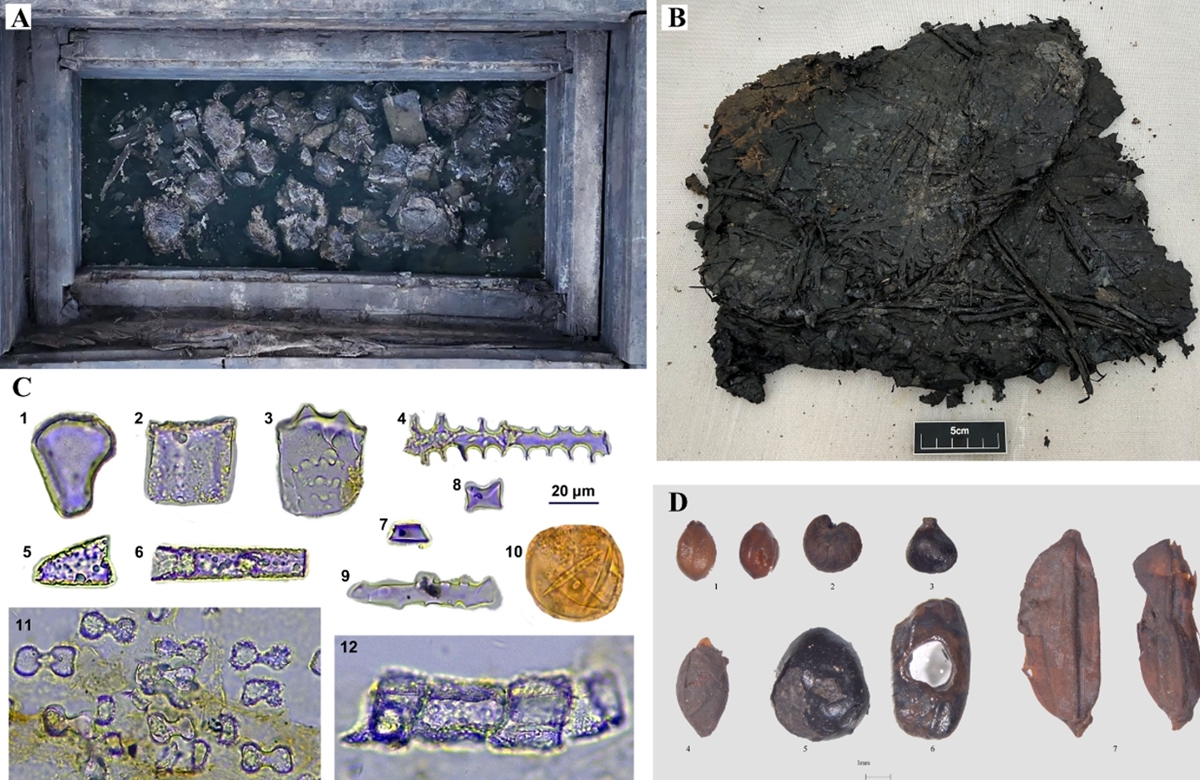
In March 2024, archaeologists from the National Center for Archaeology excavated a large number of well-preserved, waterlogged plant bundles from the tomb's outer coffin chamber. On-site, the plant bundles could be seen tightly wrapped in broad leaves and tied with plant-fiber cords.
A team of researchers led by the National Center for Archaeology, IVPP, and the Chinese Academy of Social Sciences examined 12 of the bundles and found that the wrapping leaves came from oak trees, while the cords were made from grasses.
The bundles mainly contained rice, broomcorn millet, foxtail millet, and cereal seeds, most of which were still in their husks and mixed with inflorescence material. Small amounts of peppercorn, mallow and rice-field weed seeds were also found.
The fact that the bundles were found in a tomb and mainly contained grains still in their husks suggests they were not everyday food, but offerings intended for funerary rituals. "This might reflect a Warring States-era belief that grains served as wealth for the dead in the underworld," Ge Yong, an associate researcher at the IVPP and the study's corresponding author, told the Global Times.
A Qin Dynasty (221BC-206BC) text describes a belief that "soybeans were gold and millet was money" for the dead, indicating that grains held symbolic significance in funerary culture. "The bundles therefore appear to have been ritual offerings prepared for the deceased," Ge said, "not food for the living."
The physical structure of the bundles also resembles that of zongzi, with grains wrapped in leaves and tightly secured with plant-fiber cords. "Similar practices of wrapping grains for burial have also been found elsewhere within the Chu cultural sphere," Ge said, "such as at the Chengyangcheng Site."
At the Chengyangcheng archaeological site in Henan Province, rice and broomcorn millet were also discovered wrapped in oak leaves. "An interesting fact is that we can still find zongzi wrapped with the same oak leaves now in regions related to the Chu cultural sphere."
"The findings suggest that wrapping grains as funerary offerings was a relatively common practice in the Chu state during the Warring States period," Ge said. "And this practice may have been an early form of the zongzi later associated with the legend of Qu Yuan."
These plant bundles share a structure similar to that of modern zongzi and to those described in legends and folklore. This might reflect how, through cultural exchange and heritage, these 2,200-year-old plant bundles likely evolved over centuries, shifting from sacrificial offerings to food, said Ge.
As diverse regional populations adapted the practice, it eventually transformed into the well-known Dragon Boat Festival tradition of eating zongzi. Thus, this structural resemblance might suggest a potential historical lineage; however, experts stressed that the Wuwangdun bundles should not simply be labelled as ancient zongzi.
"We can't define these plant bundles as the earliest zongzi, but rather, we can confirm that by 2,200 years ago at the latest, the Chu region had established a tradition of using this specific form of plant bundles for funeral rites. And this tradition could be a possible origin or precursor of the well-known zongzi," said Ge.
He added that the discovery provides critical physical evidence to explore the origins of zongzi and its cultural heritage.
。”24日,临汾市委常委、常务副市长胡晓刚在中共山西省委宣传部、山西省人民政府新闻办公室举办的开局起步“十五五”系列主题新闻发布会表示。 “临汾是全省的能源大市,在保障国家能源安全中肩负着重要责任。”胡晓刚介绍,“十四五”期间,临汾交出了一份成色不错的“能源答卷”。智能化矿井建成42座,先进产能占比跃升至91.5%;非常规天然气产量累计达到136.97亿方,实现五年翻番;更值得一提的是,全市新能源装机占比突破50%,标志着该市已经迈入“多能互补”的新阶段。 “十五五”时期,临汾将锚定“能源转型”任务,持续深化能源革命。胡晓刚介绍,该市将重点做好让煤炭这个“压舱石”更稳、更绿,让清洁能源这个“新引擎”马力更足,让能源消费的“含绿量”更高这三件事。 临汾的主焦煤是全国稀缺的战略资源。该市将一手抓产能接续,加快新建煤矿手续办理,推动续建项目建设,确保“十五五”末全市煤炭总产能稳定在1.4亿吨左右。另一手抓智能绿色开采,加快构建“装备+AI算法+应用”智慧矿山“临汾模式”,到2027年符合条件的生产矿井基本实现智能化,让煤矿从“汗水驱动”向“智能驱动”转变。 沿黄板块的深层煤层气是临汾巨大的资源宝藏。“十五五”该市将加快大吉煤层气田二期产能建设,推动市域内输气管道互联互通,逐步形成“成环成网、内连外畅”的管网系统,力争2030年产量达到100亿立方米,把非常规天然气打造成临汾新的支柱产业。 同时,临汾正在重点推动侯马开发区、浮山双新产业园等绿电园区试点建设,创新“绿电+先进制造业”模式,积极招引一批绿电需求大的出口型制造企业落户,把能源优势转化为产业优势。该市把“电动临汾”建设作为能源消费革命的重要突破口,全面开展与宁德时代的战略合作,一体推进换电站网络布局和电池租赁、持车运营、二手车经营服务三大平台建设。 “目前全市已规划布局41座重卡换电站,年内将逐步形成覆盖主要交通干线的换电网络,让临汾的货车也‘绿’起来,打造山西‘零碳货运走廊’的临汾样板。

B | ”胡晓刚说。

C |
Current article:http://www.senchuoshaozaodidia.shop/list_nq3w/2tqrby.html
Published on:08:14:24